A Practical Framework for Evaluating Legal AI and Automation
Can't AI do that?
For the last few years, when thinking about a manual task or process, many of my colleagues would often wonder:
“Can’t AI just do that?”
Sometimes the answer is yes.
Often it’s no.
And occasionally, the better answer is that the workflow itself needs to change before any technology will help.
The mistake many organizations make is starting with the tool instead of the work.
They evaluate products before they evaluate the task. A better approach may be to step back and ask: What kind of work is this, and what role should technology actually play in it?
Three Common Ways Work Gets Done
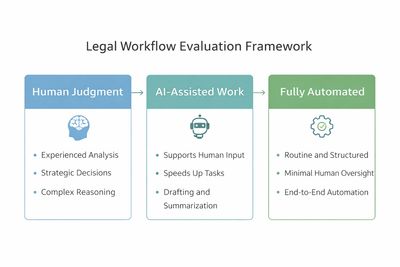
Most operational work falls into one of three categories.
Human Judgment: Some work demands experience, interpretation, and expert judgment. Examples include evaluating legal risks, strategy, and client counseling. While AI can assist with information gathering, it is important to note that the decision itself should remain human.
AI-Assisted Work: This refers to workflows in which AI enables people to work faster by organizing information, providing starting points, or identifying patterns. In this category, a person remains accountable for the ultimate outcome, but efficiency increases. Examples include document review support, drafting summaries, and legal research.
Fully Automated Work: Some tasks are so repetitive and predictable that they can be automated completely. Examples include routing intake information, generating standard document drafts, and updating systems with structured data. In these instances, automation not only accelerates the process but can eliminate the task entirely.
The Real Question to Ask
Before deciding whether AI should be involved, it helps to evaluate the task itself. When doing so, a few questions tend to reveal a lot.
How often does the task occur? Is it happening a few times a year, or dozens of times a day?
How much time does it consume? Even a simple task can become expensive if it happens constantly.
How much judgment is required? Tasks that depend heavily on interpretation tend to resist automation.
What is the risk of errors? In some workflows, mistakes are inconvenient. In others, they are unacceptable.
By considering these questions, you can more confidently determine whether AI is the right fit for your workflow.
Where Legal Work Often Falls
Legal work rarely sits entirely at one end of the spectrum. Instead, many workflows contain a mix of activities. For example, consider client intake. The initial data collection might be automated, whereas Document collection could be AI-assisted. However, evaluating the legal merits of the case still requires human judgment.
Thinking in terms of workflows instead of individual tools helps organizations determine which steps can be effectively supported by technology and which require human expertise.
Estimating the Value of Automation
Once you understand the specifics of the task, the next question is whether automation is truly worth pursuing; not every repetitive task is worth solving.
To help assess this, I built a few simple calculators that estimate the potential value of automation in operational workflows.
You can find them here:
A Common Pattern
Over the last two decades, working with legal data, analytics, and product teams, I’ve seen a consistent pattern: Organizations often rush toward technology when the real opportunity lies in redesigning the workflow itself. Sometimes automation is the answer. Sometimes the process needs to be simplified first. And sometimes the work should remain exactly where it is: in the hands of experienced professionals.
Recognizing when to redesign a workflow—rather than defaulting to technology—requires nuance. Understanding that distinction is what separates useful technology from expensive experiments.
So, if you are evaluating whether a legal workflow should be automated, AI-assisted, or left alone, the most useful place to start is not the product demo.
Technology decisions are easier when you understand the work .